Concept · Ask Your Data
Ask in plain language. Get an answer that admits how much we know.
Most people assume AI can answer any question about their data by waving a wand. It can't — and the products that pretend otherwise quietly make up numbers. Ask Your Data is the honest version.
You type a question. It runs into the same ranked index that builds your list — so the answer comes from what's already been measured, not from a number generated on the spot. And every answer is labeled by how much we actually know: a measurement, an honest estimate, or a plan to find out.
01 · The premise
The trick isn't answering. It's knowing when you can't.
See the proofHide
01 · The premise
The trick isn't answering. It's knowing when you can't.
The point isn't a chatbot. It's honesty about certainty: a measured answer, an honest estimate, or a plan to find out — never a confident guess dressed up as a fact.
A language model will always produce a fluent answer. That's the problem: fluent and correct are different things, and a confident sentence about a number you never measured is worse than silence.
So the question doesn't go to a model that improvises. It goes to the index — the precomputed, evidence-backed findings about your teams — and what comes back is graded. If your data answers it, you get the measurement. If it doesn't, you're told so, and given the next-best thing instead of a guess.
02 · The three tiers
Measured, inferred, or an honest gap.
See the proofHide
02 · The three tiers
Measured, inferred, or an honest gap.
Measured. The answer is in your data. You get the number, what it's based on, and how confident it is — e.g. a support gap of 30 points, from 46 responses, at 88% confidence — with the research findings that back it.
Inferred. Your data can't answer it alone, so we say so and give a range instead of a point: a Bayesian estimate built from research benchmarks and whatever of your data we do have. It's labeled an estimate, not a measurement, with the confidence stated. You can act on it knowing exactly what it is.
Gap. Sometimes even the estimate is too wide to be useful. Rather than narrow it artificially, we tell you the honest truth — we can't answer this well yet — and turn the dead end into a plan.
03 · The gap turns into a plan
“We can't answer that yet — here's what it would take.”
See the proofHide
03 · The gap turns into a plan
“We can't answer that yet — here's what it would take.”
When a question lands in the gap, the answer isn't an apology. It's a ranked work plan: the specific things to measure that would close the confidence gap fastest, ordered by how much each one is worth — and a button to queue the project.
This is the value-of-information idea made literal. A question we can't answer is information: it tells us exactly where the next measurement pays off most. The honest dead end becomes the most useful thing on the screen.
04 · In the product
A measured answer, with its confidence and its evidence.
See the proofHide
04 · In the product
A measured answer, with its confidence and its evidence.
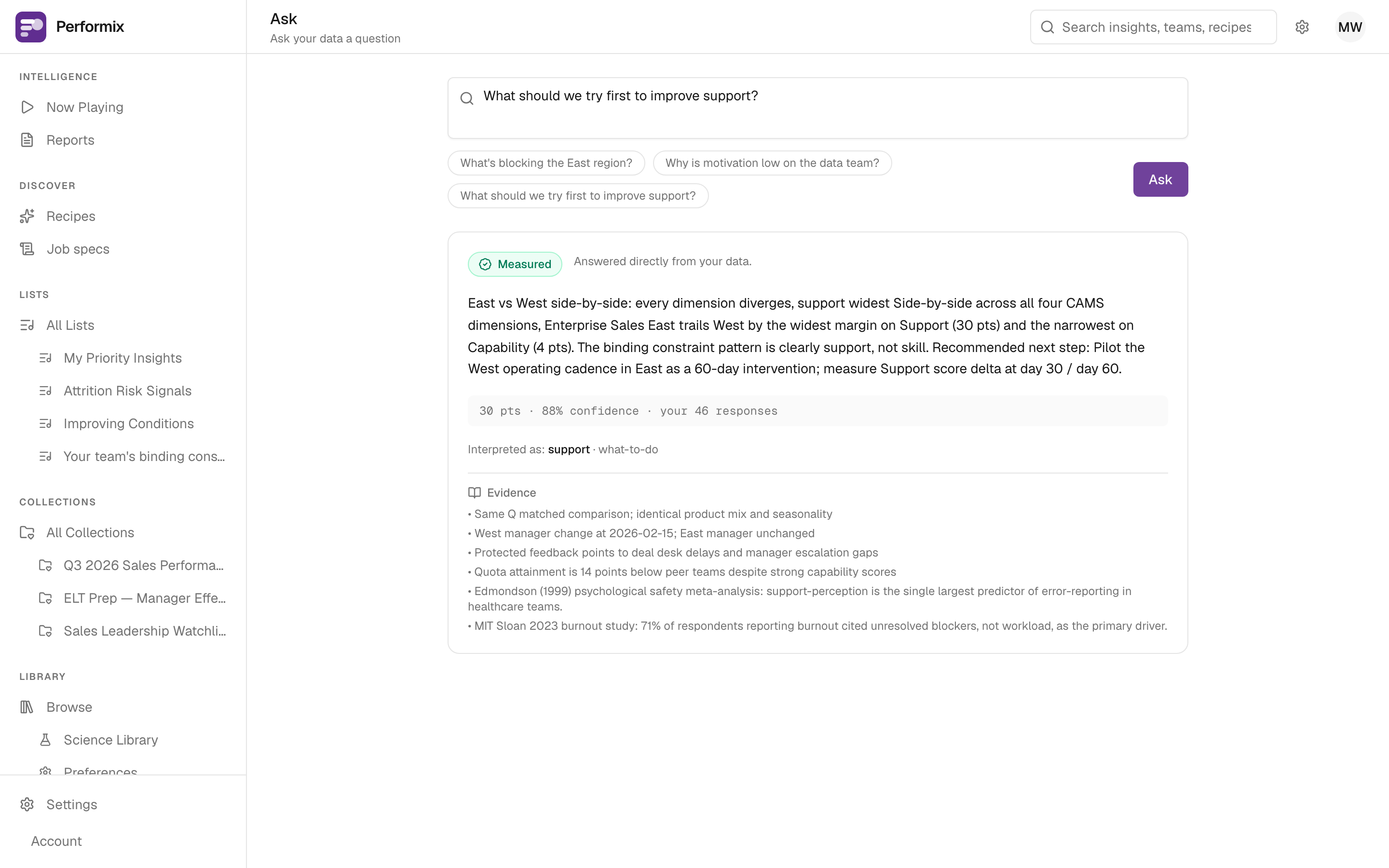
Notice what the answer shows: the tier it's answering at, the number and its confidence band, how the question was interpreted, and the evidence it drew on. The honesty is the feature.
Because it rides the same ranked index as the player, asking and browsing are one system seen two ways — a question is just a list with a query attached.