Concept · Recipes
You don't configure an analysis. You pick a recipe.
A blank analytics tool asks you to be the analyst: decide what to measure, who to ask, how to cut it, what counts as good. Most people don't have that expertise on hand — which is exactly why the analysis that would matter most usually doesn't get run.
A recipe is that expertise, packaged. It's a complete analytical path for a situation — sales performance variance, AI-work readiness, post-acquisition integration — bundling the inputs it needs, the analysis it runs, and the outputs it returns into a single thing you deploy as one decision. You choose the situation; the recipe brings the method.
01 · The recipe shop
“What do you want to learn?” — not “what chart do you want to build?”
See the proofHide
01 · The recipe shop
“What do you want to learn?” — not “what chart do you want to build?”
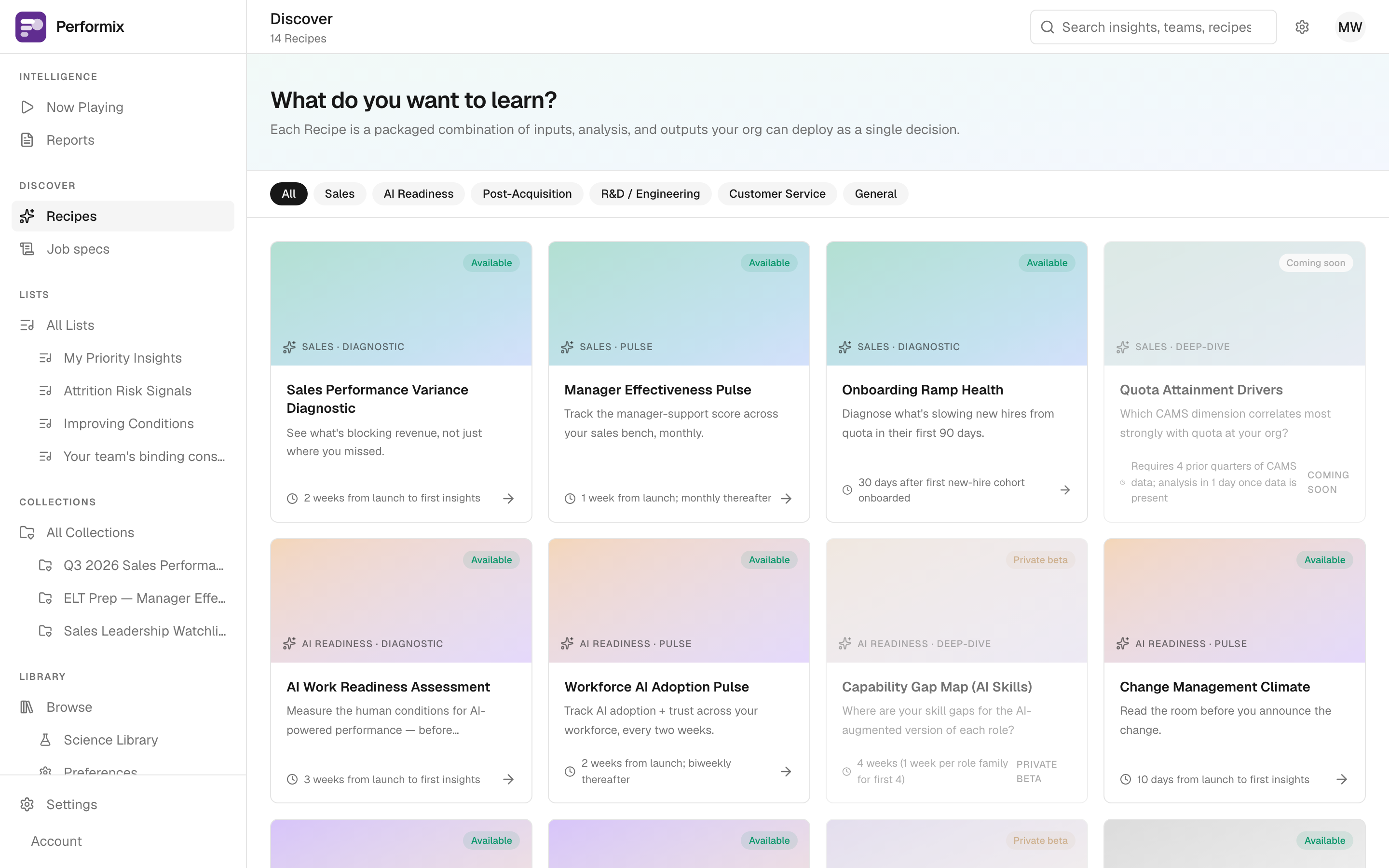
The entry point is a question about your situation, not a menu of visualizations. Browse by where you are — a sales org, an AI transformation, a post-acquisition integration — and each card tells you what it diagnoses and roughly how long until it returns something useful.
It's the iTunes “Browse” move applied to analysis: the hard, expert work of designing the study is already done and shelved, ready to play.
02 · One engine, many recipes
The engine doesn't change. The recipe specializes it to your work.
See the proofHide
02 · One engine, many recipes
The engine doesn't change. The recipe specializes it to your work.
You don't configure an analysis from a blank page. You pick the recipe for your situation, and it already knows what to measure, who to ask, what “good” means for this work, and what to hand back.
Under every recipe is the same machinery — the Triple-A frame, the CAMS diagnostic, the ranked index. What changes is the specialization: which measures matter for this work, who the right respondents are, and — the part that's easy to underrate — what “good” even means here. Good in a surgical unit is not good on a sales floor.
That last piece comes from the library. Before you pick anything, the research substrate has already absorbed what the literature knows about how performance varies by the nature of the work. The recipe is how that knowledge gets applied: it sets the analytical path, and then the path adapts to your actual responses — starting shallow and going deeper only where the answers justify it.
This is why a recipe isn't a saved dashboard. A dashboard freezes a layout. A recipe carries a method that adjusts as it learns about you.
03 · Inside a recipe
Inputs, analysis, outputs — one decision, not a project.
See the proofHide
03 · Inside a recipe
Inputs, analysis, outputs — one decision, not a project.
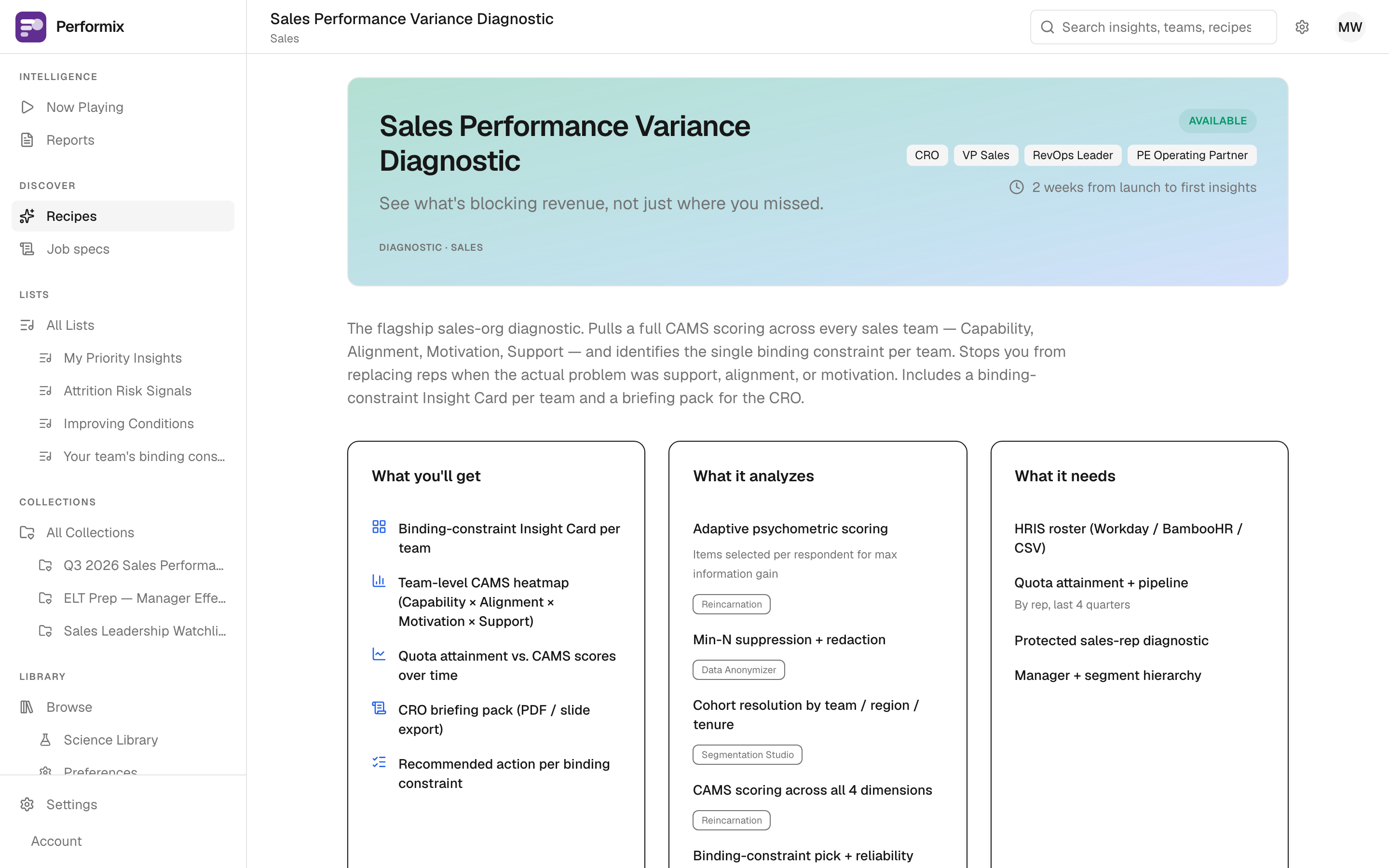
Open any recipe and it tells you the whole contract up front: what it needs from you (an HRIS roster, quota and pipeline, the right people to survey), what it does with it (adaptive psychometric scoring, minimum-N suppression, CAMS across four dimensions, the binding-constraint pick), and what you get back (a per-team insight card, a CAMS heatmap, a briefing pack, a recommended action).
No statement of work, no analyst engagement, no blank quarter of figuring out what to measure. You're agreeing to one decision: run this, on this team, and get that.
04 · What's real today
The catalog is real. Deployment is honest about its stage.
See the proofHide
04 · What's real today
The catalog is real. Deployment is honest about its stage.
The catalog and the recipes are real, and several beachheads — sales, customer service — are grounded in extracted research and running in private beta. What you see when you open a recipe is its actual contract, not a wishlist.
Deploying a recipe today runs through a scripted operator flow: a deterministic walk-through that collects credentials, resolves segments, and launches — real, but scripted, not yet an autonomous agent. When the first customer lands it becomes exactly that, on the same surface. We'd rather show you the honest version than pretend the agent already exists.